Ridgway's Color Standards and Color Nomenclature
How an American ornithologist fixed 1,115 colors to paper in 1912, and why so many of their names are still in use
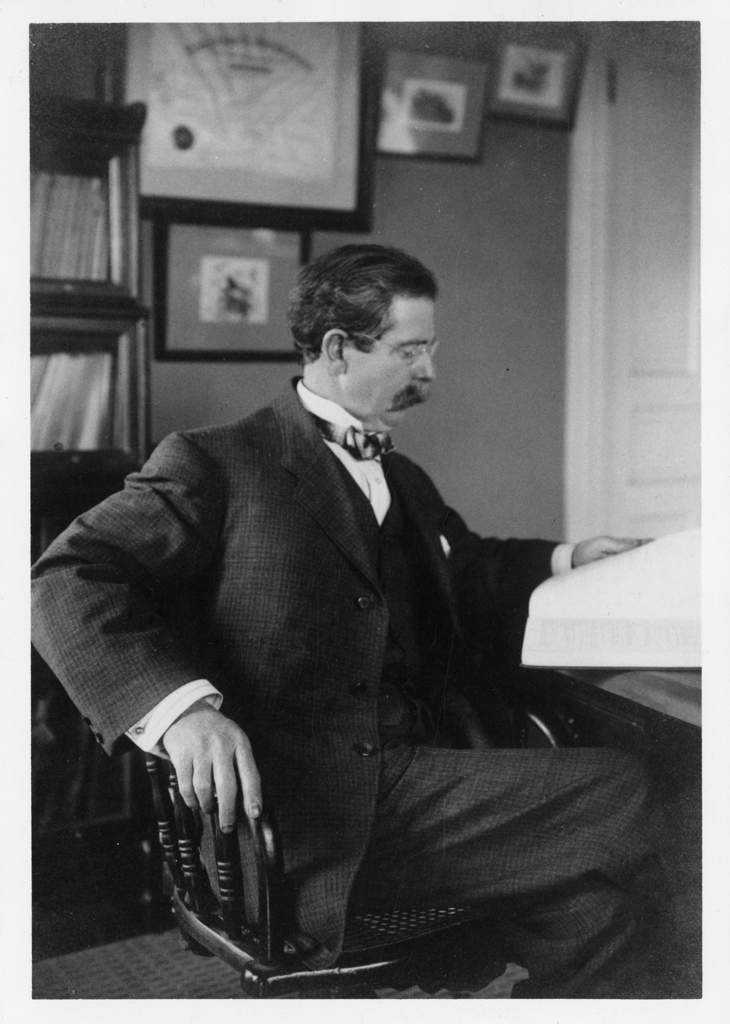
A gull's back is grey. So is the back of a different gull a few hundred miles away, and the difference between the two greys can be the difference between two species. Robert Ridgway spent his working life describing birds, and he knew that a word like "grey" was close to useless for that job. Two careful observers could look at the same feather and write down two different names, and a reader on another continent had no way to tell who was right.
His answer, published in Washington in 1912, was Color Standards and Color Nomenclature: 53 plates, 1,115 named colors, each one a small printed swatch with a name underneath. Its stated motive, set in capitals in the preface, was "the standardization of colors and color names." It became one of the most widely used color references of the early twentieth century, and many of its names are still in circulation.
The curator of birds
Ridgway was born in 1850 in Mount Carmel, Illinois. He formally joined the Smithsonian Institution in 1874, was given the title of curator in 1880, and was Curator of Birds from 1886 until his death in 1929. In 1883 he helped found the American Ornithologists' Union, and later served as its president.
His great project was The Birds of North and Middle America, a descriptive catalogue he published in installments from 1901. He finished eight parts before he died; the remaining volumes were completed by others. A work like that is mostly description, and much of the description is color: the crown, the wing coverts, the iris, the bill, the legs. His biographer Daniel Lewis judged that Ridgway may have had the best grasp of bird coloration in the country.
A first attempt in 1886
The 1912 book was Ridgway's second try. In 1886 he published A Nomenclature of Colors for Naturalists, with 186 colors on ten plates. It was used by zoologists for about twenty-five years, and Ridgway was not satisfied with it. In the later preface he calls it an improvement on what came before but seriously deficient, both in the number of colors and in how they were arranged.
He did not throw it away. Because so many published descriptions already used the 1886 names, he kept every old standard that could be matched in the new system, and marked them so readers could follow the thread from one book to the other. A naturalist who had written up a specimen in 1890 could still be understood in 1915.
How the plates are arranged
The new book is built on a system rather than a list. Ridgway started from the solar spectrum and closed it into a circle by adding the purples and red-violets that the spectrum lacks. He divided that circle into 36 hues, which he considered the practical limit for the eye, and fixed each hue by spinning colored disks on a color wheel (Maxwell disks) and recording the proportions of the two neighboring colors that produced it.
Each hue then runs in two directions. Mixed with increasing amounts of white it gives a series of tints; mixed with black it gives a series of shades. On the plates these steps are marked with letters, so a color might be tint b, d or f, or shade i, k or m. Hermosa Pink, the first color on Plate I, is a tint f of hue 1, the spectrum red.
The third dimension is greyness. Ridgway called colors dulled with neutral grey "broken" colors, and marked them with primes after the hue number. Each added prime means more grey: by his figures the series contain 32, 58, 77, 90 and 95.5 percent grey. A hue number with four primes is a color most of the way to grey, which is exactly the territory where bird descriptions live. The book ends with the neutral greys themselves, on Plate LIII, where Slate-Gray and Neutral Gray sit a few steps apart. Those two names, according to a later account in Audubon magazine, helped ornithologists tell the wing of a California Gull from that of a Herring Gull.
The result is that every color in the book has an address as well as a name. Isabella Color is not only a greyish yellow-brown; it is a specific hue, with a specific amount of grey, at a specific depth of shade, on Plate XXX. Someone without the book could at least locate it within the system.
Printing 1,115 swatches
A color standard is only useful if every copy matches. Ridgway's swatches were not printed directly onto the book's pages. The colors were produced as large printed sheets by A. Hoen & Company of Baltimore, cut into small rectangles about an inch by an inch and a half, and pasted by hand into each bound copy. Ridgway credits Hoen's chemist and head colorist with solving the reproduction problems, and says more than three years went into getting the colors right.
He published the book himself, partly with a loan from his friend José Castulo Zeledón, the Costa Rican ornithologist. Audubon puts the print run at about 5,000 copies.
Ridgway was frank about the book's weak point. Some of the dyes were permanent, but the green and violet aniline dyes he describes as very evanescent, and he warns readers to keep the plates out of direct sunlight. A century later, surviving copies vary, and some greens and violets have visibly shifted.
A long afterlife
The book was made for naturalists, and they used it for decades, to describe plumage, plants and specimens of every kind. It travelled well beyond ornithology. Audubon lists stamp collectors, designers and people working on food color among its users. Heavily thumbed field copies still turn up in the secondhand trade.
It was also absorbed into later systems. In 1949 the Journal of the Optical Society of America published D. H. Hamly's key giving Munsell notations for the Ridgway standards, which let the old names be translated into a modern, measured color space. Munsell space is also where the later ISCC–NBS system of color names is defined, so the Ridgway names could be placed alongside it.
By the middle of the century, pocket field guides and color photography had taken over much of the book's everyday work. But the names had already spread into thousands of published descriptions, and they stayed there.
Ridgway's names in Sanzo Wada
They also turn up somewhere less expected. Many of the English color names in Sanzo Wada's A Dictionary of Color Combinations, the Japanese color book published from 1933, are Ridgway's: Hermosa Pink, Isabella Color, Calamine Blue, Cotinga Purple. Comparing the two lists on this site, 122 of the 159 Sanzo Wada colors carry a Ridgway name, a few of them misspelled in the widely shared dataset (Sulpher Yellow for Ridgway's Sulphur Yellow, Cerulian Blue for Cerulean Blue). Each Ridgway color page shows its Sanzo Wada namesake where there is one.
I have not found a source that explains how Ridgway's names reached the English edition of Wada's book, so this is an observation from the lists rather than a claim about Wada's method. It does show how far the 1912 vocabulary travelled.
A note on the hex values
The Ridgway collection on espectro.dev gives every color a hex value, plate by plate. Those values were sampled from the scans in the Project Gutenberg edition, which photograph one printed copy, a century old, under one set of lighting conditions. They are useful approximations, not Ridgway's swatches. The greens and violets, the colors he worried about most, are the ones to treat with the most caution.
That limitation is in the spirit of the book. Ridgway's real achievement was not any single swatch but the address system around them: hue number, tint or shade, degree of grey, and a name. The swatches fade; the system still tells you where a color belongs.
Sources
- Robert Ridgway, Color Standards and Color Nomenclature (Washington: published by the author, 1912). Public domain. Project Gutenberg; Smithsonian Libraries. Details of the hue circle, the grey percentages, the printing and the fading dyes come from the preface.
- Robert Ridgway, A Nomenclature of Colors for Naturalists (Boston: Little, Brown, 1886).
- Wikipedia, "Robert Ridgway." en.wikipedia.org
- "Long Before Pantone, This Bird-Based System for Describing Color Was a Hit," Audubon. audubon.org
- D. H. Hamly, "The Ridgway Color Standards with a Munsell Notation Key," Journal of the Optical Society of America 39 (1949), 592–599.
- Hex values: davo/Color-Standards-and-Color-Nomenclature (MIT License).