Werner's Nomenclature of Colours
A naturalist's color dictionary from 1814, and what it teaches about naming colors
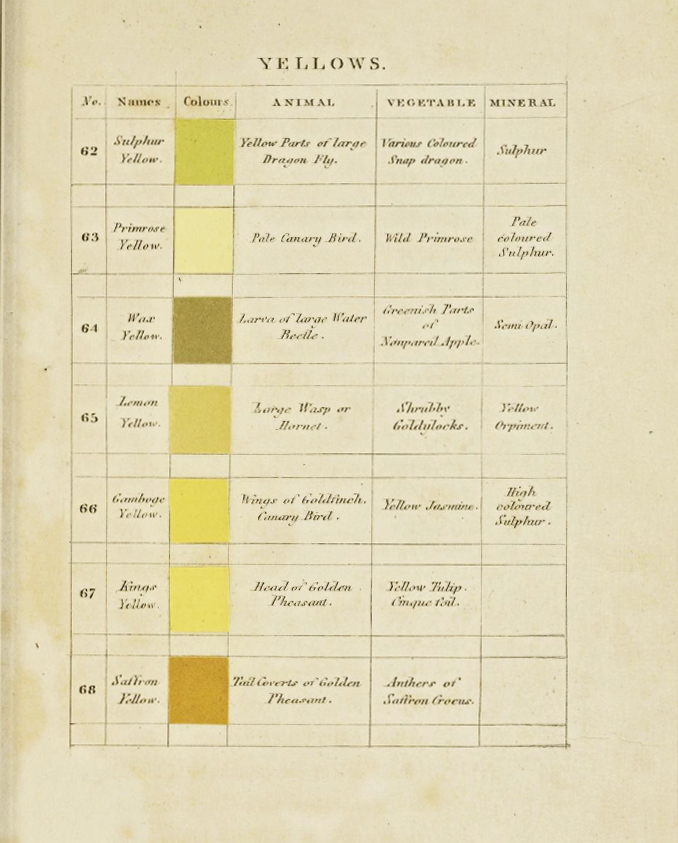
Before photography, a naturalist who wanted to record the color of a bird's plumage or a fish's scales had only words, and the words were unreliable. One writer's "dark blue" was another's "slate," and neither could be checked by a reader on the other side of the world. Werner's Nomenclature of Colours, published in Edinburgh in 1814 and reissued in an expanded second edition in 1821, was an attempt to fix that. It is a small book of painted swatches with names and descriptions, and its method is still one of the clearest models for building a shared color vocabulary.
A mineralogist's scheme, a painter's book
The system began with Abraham Gottlob Werner (1749–1817), a German geologist. In his 1774 book on the external characters of minerals, translated into English in 1805 as Treatise on the External Characters of Fossils, Werner set out a scheme for describing minerals by what could be seen, and color was one of the main characters. He named a series of tints and described each one by its component parts.
Patrick Syme (1774–1845), a Scottish flower painter who worked for the Wernerian and Horticultural Societies of Edinburgh, turned that scheme into a reference book. The preface of the 1821 edition explains how. With the help of Professor Jameson, who arranged a set of mineral specimens illustrating Werner's colors, Syme copied the color of each mineral by hand and checked it against Werner's descriptions. Jameson, quoted in the same edition, says the specimens were a color suite of minerals made under Werner's own supervision.
Syme was candid about whose idea it was. The preface credits Werner with suggesting it, and states the aim plainly: "To remove the present confusion in the names of colours."
According to Syme, Werner's suites of colors ran to seventy-nine tints. That was enough for minerals but not for describing plants and animals, so Syme extended the list to 110, which he called standard colors. His additions are marked in the book; every color taken from Werner carries the letter W.
He also changed the structure. Werner had folded purple into blue and orange into yellow. Syme disagreed, and gave Orange and Purple their own sections, which meant moving or renaming a few of Werner's colors. A list at the back of the 1821 edition records every name that changed, so a reader could map the new names back to the old ones.
The book leaves some things out on purpose. Metallic colors are excluded because painted versions would tarnish, and because everyone already knew what gold, silver and copper looked like. Iridescence, the play of color in a pigeon's neck, a peacock's tail or an opal, is left out because it cannot be painted on a flat page.
Syme also explained how to go beyond the 110. Applying terms such as pale, deep, dark, bright and dull to a standard color, or tinging it with grey, black or brown, could in his estimate multiply the tints to more than thirty thousand. The standard colors were anchors, not the full range.
Snow White, Scotch Blue, Verdigris Green
Each color in the book gets a number, a name, a painted swatch, a short note on its composition, and up to three examples from nature, one each from the Animal, Vegetable and Mineral kingdoms.
The first entry sets the pattern. "No. 1. Snow White, is the characteristic colour of the whites; it is the purest white colour." Its examples are the breast of the black-headed gull, the snowdrop, and marble.
Skimmed Milk White is the white of the human eyeball, the back of the petals of blue hepatica, and common opal. Scotch Blue is the throat of the blue titmouse, the stamens of the single purple anemone, and blue copper ore.
The composition notes read like a recipe. "Verdigris Green, is composed of emerald green, much Berlin blue, and a little white." Verdigris Green is defined by the colors it is made of, which are themselves entries in the book. The system refers back to itself.
Werner's method for colors that fall between the standards is just as practical. A color that approaches another slightly is said to incline toward it; one in the middle is intermediate; one that comes very close is said to pass into it. That is a small, precise vocabulary for describing difference, which is exactly what describing a color in words needs.
Darwin's copy on the Beagle
The book's best-known reader is Charles Darwin, who took a copy on the voyage of HMS Beagle. Darwin Online, which publishes a digitized 1821 edition, describes how he used it to record the colors of specimens that preserving fluids would fade or destroy. Richard Keynes, writing on Darwin's zoological notes from the voyage, observed that the color names Darwin put in quotation marks were taken from Werner's book. Darwin Online's examples include a snake recorded in his 1835 field notebook as "primrose yellow," one of Syme's named colors.
That is the book doing exactly the job Syme designed it for. Darwin could not bring a living fish home with its colors intact, but he could bring home a name that pointed to a specific painted swatch in a book other naturalists also owned.
Naming colors after things, not numbers
The lasting lesson is in the naming. Werner and Syme did not number their colors in a sequence and leave it there. They gave each color a name and tied it to things people had seen: snow, a gull's breast, a mineral in a cabinet. A name like Scotch Blue says nothing on its own, but once linked to the throat of a blue titmouse it becomes something a reader can check against the world.
A number is easy to sort but says nothing about the color. A name tied to a familiar object can be remembered, repeated and checked. That is why Darwin could write "primrose yellow" in a notebook and trust that another naturalist, with the same book, would know what he meant.
Named colors versus combinations
Werner's book and Sanzo Wada's A Dictionary of Color Combinations both come from old color dictionaries, but they answer different questions. Werner's is a color system: a set of individually named colors, each defined on its own, designed so that two people describing one object would choose the same word. It says nothing about which colors look good together.
Wada's dictionary is a book of combinations. Its colors matter mostly in relation to one another, as pairs, threes and fours chosen to work as a group. Werner gives you a vocabulary of single colors; Wada gives you tested groups of them. One tells you what a color is called, the other what it goes with.
A note on the hex values
The Werner collection on espectro.dev gives each color a digital value so it can be used in code. Those values are approximations. Syme mixed and painted every swatch by hand, and he acknowledged that even his careful method left colors vulnerable to long exposure to sunlight. Two centuries on, surviving copies have aged pigments and yellowed paper, and the values available today come from scans, which add their own lighting and color-profile shifts. Different copies and different scans give different results.
The values are a reasonable starting point, not a reconstruction of what Syme saw on his palette. That is in keeping with the book itself. Syme's swatches were never meant to stand alone; each came with words and examples that let a reader check the color against the world. The names and descriptions are the most durable part of the system, and they are the part worth borrowing.
Sources
- Patrick Syme, Werner's Nomenclature of Colours, with Additions, second edition (Edinburgh: William Blackwood; London: T. Cadell, 1821). Public domain. Internet Archive scan. All quotations from the book in this article come from this edition.
- Darwin Online, Werner's Nomenclature of Colours (1821), with an introduction on Darwin's use of the book during the Beagle voyage. darwin-online.org.uk
- The Public Domain Review, "Werner's Nomenclature of Colours (1814)." publicdomainreview.org
- Wikipedia, "Abraham Gottlob Werner." en.wikipedia.org
- Wikipedia, "Patrick Syme." en.wikipedia.org
- Sanzo Wada, A Dictionary of Color Combinations, browsable on espectro.dev at /sanzo-wada.